
 Posts
Posts




Friday, March 25, 2011
Art Reveal-- Indian contemporary Art n artists: artists and their art In present--good bad and ind...
Art Reveal-- Indian contemporary Art n artists: artists and their art In present--good bad and ind...: "' Even in art many desire the linearity of the familiar. There are artists who feel satisfied to repeat, for it puts no burden of searching..."

Monday, March 21, 2011
Saturday, March 19, 2011
India n Rajasthan--Beyond ordinary art, culture n philosophy
India after Independence had to fight on many fronts. Besides fighting demeaning poverty imposed by the British and Portuguese Colonists India had to fight to recover and purify its fine arts. Indian music, classical and folk dances, local folk theatre, songs and performances remained largely free from colonial influence. But same could not be said about visual fine arts--sculptures, paintings and drawings. The 'teaching' of Western European rules in creation of art in British created colleges implanted and bastardized Indian art practices into alien beliefs and concepts of aesthetics. The sad part is that British totally destroyed the philosophy and beliefs even in appreciating art. They judged Indian art as good if it fitted the Western rules of aesthetics; thus all local variations of art practiced by Indians were tagged as primitive and inferior to the canon.
The sad story is that this Eurocentrism still decides in terms of aesthetics and 'value' the worth of art anywhere in the world including India. My travels across India and specially in Rajasthan could help me to study and compare Indian art with the Western art. Using Indian aesthetics and philosophy I carried out detailed analysis the result of which I present in my book Mona Lisa does not smile anymore.
I have only this to say do not see Indian art with European glasses. The history and culture of our land is different from that of West and understanding of our art has to be with Indian glasses, only then you will appreciate its finer point. The fragrance of fire cooked tikde ( thick chapati made in Rajasthan) can not be compared with factory made bread.

 My land and my people have kept our arts and culture alive, but we should not give up under globalization what was created by our forefathers over thousands of years. Go to Ahad Museum 2 km from Udaipur and you will understand what our forefathers created 5000 years BP.
The sad story is that this Eurocentrism still decides in terms of aesthetics and 'value' the worth of art anywhere in the world including India. My travels across India and specially in Rajasthan could help me to study and compare Indian art with the Western art. Using Indian aesthetics and philosophy I carried out detailed analysis the result of which I present in my book Mona Lisa does not smile anymore.
I have only this to say do not see Indian art with European glasses. The history and culture of our land is different from that of West and understanding of our art has to be with Indian glasses, only then you will appreciate its finer point. The fragrance of fire cooked tikde ( thick chapati made in Rajasthan) can not be compared with factory made bread.


Thursday, March 17, 2011
The Durga in Rajasthan--Jhalra-Patan
 Only in India that we have God in the form of woman. The Durga is a Goddess who leads in giving life, learning, destroying dark forces, and giving a boon of prosperity. From Rajasthan we used to have uncomfortable news about girl children and women. I hope what i saw recently may be true in a general way for Rajasthan. As I travelled across the state I saw girls of different ages going to school in hordes. I found better roads and parents putting their children on the bus and requesting the conductor to put the children down near their schools. The girl children also looked healthier. Though I know more needs to be done for nutrition of mothers, women, and children. The mid-day meals that I randomly was a witness to had at least very basic nutrion for the children.
Let the State, the opinion makers and people come together to take care of the real Durga and see to it that no child or woman is undernourished only then the blessings of Goddess can be reaped.
The Durga above is so beautiful and has a smile of blessing that is much sweeter than on the more famous painting of Mona Lisa. Look at her soft smile as if your own mother blesses you while she fights a difficult life to protect you. This Durga is from the Sun Temple of Jhalra-Patan town that touches me so deep. Indian art is one of the most Humanistic of religious arts anywhere in the world. This is the reason I felt to put this beautiful Ast-Bhuja (eight-armed) Durga in my book on Indian art and culture--Mona Lisa does not smile anymore. May our
Durgas as mothers and daughters become strong and healthy in health!!
Saturday, March 12, 2011
Jhalrapatan, Jhalawar Rajasthan


My new book on Indian art Mona Lisa does not smile anymore owes a lot to Rajasthan in general and Jhalwar in particular. As I travelled time and again to Rajasthan trying to learn the great history of art of India, I garnered fresh insights in the minds of Indian artists from this part of my beautiful country. The areas of Bundi, Jhalwar, Kolvi, Menal, Bijolia, Kota have a common cultural heritage. The people of these areas even today are saturated in their cultural traditions. Almost in all the wonderfully exquisite temples that I visited in this area even today reflect same kind of simplicity of faith that created these temples a 1000 years or so earlier. This is true of all the Rajasthan. I met in these pristine old temples the simple, poor folk of my country incomparable in the warm welcoming smiles and they gave affection strangers rarely get anywhere.
In this Blog post I express my deepest gratitude and thankfulness to these great Indian. What is heartening is that the spiritual and social light of these folks was understood very well by the artists, sculptors, painters of India from centuries past. On the wall of all temples are gods and goddesses but are also simple village folk who are carrying on their daily activities or are rejoicing in the music and dance. Such a cameo of the life of ordinary people I did not find anywhere in the world including Europe, where the focus is mostly on religious narrative.
Some European historians suggest that Indians being laid back and fatalist I have refuted in my Mona Lisa...book. Indians from time past never questioned or denigrated other cultures and faiths though they kept to their own in harshest of circumstances. The faith of Indians is a fine example of freedom in religion. There is no organised centralised religious control. There is no dominant religious authority that controls and guides the laity. The God is personalised and a village farmer or an artisan making pottery is as free to find his communion with higher powers as a rich industrialist living in a 2 billion dollar mansion.
I owe this insight to the common people of India who never hold themselves back from sharing their simple joys in religion and with other humans.
Monday, March 7, 2011
Wednesday, March 2, 2011
Tuesday, March 1, 2011
Jhalawar, Jhalra patan special page of history of India n Rajasthan


Jhalawar is no ordinary town. It had so much of history around it. Chndrabhaga temples and Jhlrapatan were ancient towns of India Rajasthan. The trade route from India to Sumer and Akkad and thence to Europe ran through Jhalrapatan. It was an important stoppage point for the traders who moved with precious cargo of muslin, diamonds, pearls, lapis lazuli and other rare gems, spices etc. The town even today has not given up the memory of its past grandeur. The architecture of the Jhalra Patan takes you to its hoary past greatness and though the trade has diminished still the town retains pride in its glories of time gone.
In my book Mona Lisa does not smile anymore I have given pride of place to Jhalrapatan in whole of Rajasthan. The cover of my book is a beautiful Devi sculpture from Shantinath Jain temple. The sculpture is carved in two types of stone and then glued together. The temple is a gem of Indian art and culture. Contemporary and modern arts of India need to draw inspiration from great art Shantinath Jain temple holds in its bosom. My book Mona Lisa does not smile anymore is also a homage to Indian art and culture and Rajasthan and Jain community hold a pride of place in it.
Thursday, February 24, 2011
A book on Indian art-Mona Lisa does not smile anymore

Indian art through time Mona Lisa does not smile anymore by Viktor Vijay
The cover picture is from Jhlrapatan Shantinath Jain Temple
Wednesday, February 16, 2011
JHALRA-PATAN temple picture is the cover of my book 'Mona Lisa does not smile anymore


I have spent a lot of time in the beautiful Jhalra-patan, Kolvi, Bundi, Menal and Bijolia. My new book has many pictures from the temples of this area. The book is published by Gallery Studio Vasant Delhi. As my gallery they have hosted my latest solo exhibition of paintings calles Chancon or Chance-Consciousness Art
Thursday, January 6, 2011
Jainism--non-violence and Business
 Ranakpur Jain Temple
jainism alongside Buddhism is a great religion of Peace. The Jains not only traded internationally but also built great artistic and architectural wonders. from Karnataka, Gujrat, to Rajasthan you have many fine examples of extreme in art. while the temples of Ranakpur and Delwara in Mount Abu are resplendent and opulent the great Bahubali Gomateswar in south karnataka is example of the frugal serenity (along with Jain temples of Ellora, Halebid). The intricate marble carving in Delwara and Ranakpur temples is matchless anywhere in the world.
Tuesday, December 7, 2010
Indian art more sublime than Europe 'Renaissance' ----the life of time on surya mandir Jhalrapatan
 Timeless beauty--Forever Young
the mandap Surya mandir--a place for social gatherings

 great art in stone and a history of the times
 Loving Couple--Premi Yugal
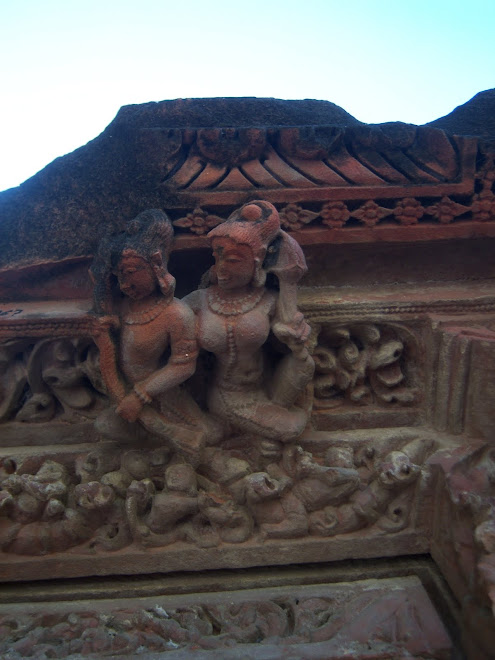
the temples in India from ancient times made God part of shared space with the people. The life of the times comes on the temple walls. The beauty of men and women, their dresses, headgear, ornaments, hairstyles and their social life--the singing, the playing of music, dancing, making love, mother and her child, and loving affectionate couples and worship.
the temples were a great statement of art, beauty, and joy in timeless youthfulness of the gods and of ordinary people. the finely proportioned ideal beauty of goddesses and of ordinary women was
from the blessed domain of akshat yauvan--eternal youth. It gave people visiting the temple greater joy and positive energy to work, relax and worship.
Friday, December 3, 2010


Thursday, December 2, 2010
Living 1100 year old past visits the present
 learning--praying with father
what touches me most is that i can see the great beauty on the walls of Shantinathji and Sun temples still reflected in the streets of Jhalrapatan. The city lives on we do not know since when; the 10th century sun temple is but one intermediate point in its historicity.
the golden marigold flowers like the rays of morning sun that kiss the Sun temple first thing in the morning, the matronly ladies lovingly string together in necklaces of these fiery flowers to adorn the gods. Nothing has changed since 1100 years and the temple had the same sun-coloured flowers around gods and goddesses.
Like the father who brings his son every morning to the temple to pray to gods for bounty for the land and its people, to give the right thought, kindness and compassion is just the way it was 1100 years earlier. the beautfiful bangles and the necklaces that adorned lovely ladies necks and arms are still being made near the temple and women crowd in the shops as they did 1100 years before.
Is it less wonderful that the priest sh. Purushottam Ji recites the same shlokas to invoke gods as they did 1100 years past.
Is it not wonderful to have the same fragrance of incense waft from the temple to the streets around as it used to 11 centuries back in time.
Is it not wonderful to find Jhalrapatan of yore in today's Jhalrapatan?
Tuesday, November 30, 2010


Sunday, November 28, 2010
Buddha in Jhalawar--Kolvi Caves
 Buddha --Meditating
 Buddha Standing
 Chaitya
 Buddha--kolvi
The time as I said earlier is a snail in Jhalawar. You may arrive as a stranger but you will go back as family and friend is the culture and the sweetness of Jhalawaris. Kush Sherma whose great help to see the exiquisite art in Garh Palace I have already mentioned suggested to me take an early morning bus to Dag to enable me to visit Buddhist Kolvi Caves. I took a bus 6AM (Jhalawar to Banswara) from near the Rajasthan Tourism Office in Jhalawar. The bus drove through small villages, taking passengers, there were a lot of sheep on the road and colourful women shepherd in their exotic jewelery saw to it that no ewe is left behind, the sheep dog also worked hard to maintain order in flock. Some tribal women got on to the bus and their red and blue skirts and mirror work on shirts and armful of white bangles were distinct. it was about 95 kms. to Kolvi. The bus left me on the road and went on further to Dag another 10 kms from kolvi. I walked on a fine tarred road arrived in open country and small settlements. A water pond had women come down to wash clothes while the cattle cooled in the water.
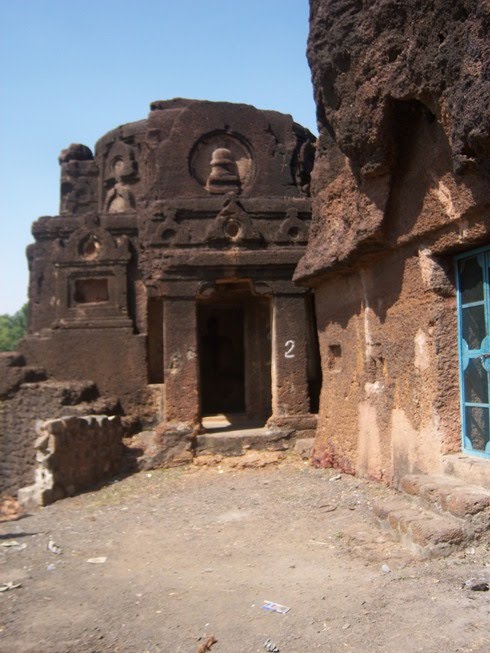
Walking about 3 kms i arrived near a small hillock. I noticed ASI board about Kolvi caves. i went up the hill and there was total silence only the sound of wind. the foliage swayed in wind and I could see far the sun burnt landscape. At leisure I explored the caves 35 of which still remain out a more than 50. The weathering by elements has destroyed the sutpas and Chaityas. the caves had the stone bed for the monks to sleep on. from the doors of caves which mostly opened to the valley bellow it would have been a stupendous view of forests, and wilderness more than 1500 hundred years before. the vegetation might have been different 1500 years before. the monks must have had fruits from the trees in the forest and food brought from villages. I could feel the presence of monks their discussions on Dhamma and their simple spiritual lives.
I understand that these caves continued in use till at least 12th century which speaks for the popularity of Buddhism in the area. There was a giant sized standing Buddha sculpture and many in meditative posture. erosion has taken its toll but still the place gave me a feeling of peace and a distance from the world of humans into serene nature. in one of the caves someone has put an idol and i could feel that locals visit and worship. So in India nothing dies, faith keeps alive 1500 years after the monks prayed for Nirvana. i spent quite many hours in this little hill of peace. had a banana and few biscuits and washed them down with a couple of swigs of water from the bottle. I walked back the women and men worked their farms, tethered the oxen to the carts and children played and ran around in joy. Soon another bus appeared and I went to Dag a small dusty town. I took some mango drink and walked around. Farmers brought grains and lentils to sell in the shops. People shopped for shoes and clothes, utensils and groceries. This was my India not the CFL powered glitter of big cities but the sinewy, hardy, sturdy farmers' world of simplicity and modest desires. The honest toil visible on the faces of men with their dauntingly large mustaches and bright headgear the women elegant in their bronzed faces from honest and hard labour in fields and at home.
Note-- take water and food with you for in Kolvi there is nothing. Have a sun hat while you walk up to the caves in strong tropical sun. Travel by the local bus you will learn more about people and culture. Near Dag are more caves if you would like to visit
Thursday, November 25, 2010
Jhalrapatan--In search of Lost time
 sculpture Shantinath Temple Jhalrapatan
Painted sculpture Shantinath Temple Jhalrapatan

Dipak(L) n Rajendra--ancient to contemporary
Shantinath Temple sculpture
Jhalrapatan has an ambiance that allows time to slow and the life to magnify. I walked the beautiful old streets--they are more like the old Italian cobbled streets where you feel that a Roman Legion's footfalls have died down a while ago. As I walked to arrive from Sun Temple to Shantinath Jain temple I found a neat sweet shop tucked in a corner. I walked in to a welcome from the owner. Indian sweets are delight in taste and in variety, and like a greedy child i eyed different sweets. I asked for small helping of rabadi then went on to another and yet another. With the nice taste in mouth I landed on the doors of Shantinath Temple. The doorway painted in oil paint with images and arabesque in warm pleasing welcoming colours, I entered the temple and was greeted by some temple officials who were busy writing in their laarge notebooks or bahis. the temple was constructed in 11th century by Shah Pipa. The temple is a living heritage. The sculptures on the temple are a novelty of artistic creation. I discovered that the breasts of the female figures were rendered in two types of stones--white and red. the round red coloured stone is pasted over white stone. In no other temple I have seen this kind of multicoloured stone use.
in the corridor on the outer front wall of Shantinath temple are neat, spruced small rooms for the devotees who come from long distances and must lodge overnight. The old world of hospitality continues in living temples of India. Clean whitewashed houses stand as history book of past in the streets and modern and ancient breathe together without any contradiction. A cybercafe rubs shoulder with a temple, flower seller comes with fresh flowers for offerings to gods to begin another day thanking God for the sun, moon, earth and sky and of course life.
As I walked leisurely near Shantinath temple i see this large high ceilinged books and stationery shop. I asked the young owner for a book on Jhalawar by historian Lalit Sherma. Deepak Podwal the owner tries to find the book but could not. I enter into conversation with him on the temple sculptures and architecture of 11the century Jain temple. I also meet a gentleman by name Rajendra who is student in the Engineering College in Jhalawar. Jhalawar has lately got many professional education colleges and is now a place where young men and women meet and live in the town to educate themselves to improve their and India's prospects in a modern world. Rajendra is full of bonhomie and pure white energy.
I intend to meet them as I visit the town again to further study the art and architecture of the area.
Monday, November 15, 2010
A Journey back to 1000 years in time--Jhalrapatan
 Jhalrapatan-shantinath mandir
 Flower-seller by the Surya Mandir
 Nursing past memories
 The Cylindrical jharokha has emerged from a grand Palace of yore
 A tiny diamond sitting over a ring of crass commercial base
When you walk in the Jhalrapatan you suddenly seem to distrust your senses. A world as in all probability as it might have existed a thousand years earlier flourishes in the thoughts, life, rituals,economic activities, social life. The streets as you walk them offer you architectural memories from several centuries gone by. A styled cylindrical latticed Jharokha in a smaller avatar seems to descend from mighty heights of a Rajput Palace. A grand pillared entrance of a majestic residence of yore is reflected in a tiny first floor apartment nudging a sturdy tree growing in the courtyard of neighbouring house. sometimes you discover a tiny but very beautiful gem fixed on an inept ring of a garishly painted shop on ground floor. As you walk where your feet take you, you may come face to face with a house going in amnesia about its glorious history.
Besides houses it is the humming life of people that will deposit you back in centuries. There are a number of jewelery shops where the gold or silversmith is working his art for the pleasure of decorating the persona of handsome women of the place. the gold/silversmith are in large numbers here for th.e women are no different from the ones you see so bejeweled on the Surya and Shantinath temples. Continued distrust of your senses makes you feel that the women you see have just come of the temple wall. these smiths still produce the designs that decorate the temple sculptures. The women selling flowers by temple steps seem to be there from time when these temples were built.
further afield you find women in rainbow colours shopping for garments. The clothiers are aplenty for their forefathers were carrying he best textiles from here to Rome in camel cart caravans. If you have not traveled here you would not understand what kind of clothes the ladies shop for. on the soft colourful blouses and skirts there is lavished as much attention as parents lavish on an only child. There is very elegant embroidery in different colour threads, millions of moon shapes shiny mirrors, sequins in all imaginable forms, and the finest and bold designs.
As I told you if you do not trust your senses you may enter this veritable castle of time past, flourishing in present.
Sunday, November 14, 2010
Jhalawar--the Renaissance in making
 The beautiful pottery and its creator
 another lovely creation of the artist--woven baskets, leaf-carpets and brooms all from Nature and totally envirionment friendly
 Bhawani Natyasala--it had seen glorious days; hope they will come back
Jhalawar does not evoke much interest either in historians, social scientists, tourists or the rulers. it is a small and peripheral area and was never ruled by larger dynasties of Rajasthan. As a political unit it has a shorter history. But small can also be beautiful. If you want to explore the soul of a place and its people, Jhalawar has plenty to offer. if you do not feel comfortable among milling crowds and tourism industry products, it can be the right place for you. Like the double edged sword it had to bear along with rest of country the British oppressive rule along with the the possibility of not so benevolent local rulers. The life for ordinary peasants and the small artisans was never good. They had to work hard to pay high taxes even if their crops failed. the story of famines was accentuated throughout India by the exploitative policies and taxes Britishers imposed on the hapless peasants. All empires were run by taxing the peasant, trader and the artisans by the rulers and the Colonial blood-suckers --the British.
In this Continent of Circe came a whiz of fresh air in the form of Bhawani Singh--the erstwhile ruler of Jhalawar. He is credited with bringing a Renaissance to the laid back Jhalawar. He opened Schools, College, libraries, hospitals, girls hostel, Bhawani Natyasala --a space for theatre and the first Museum in Rajasthan in 1915. He laid a foundation for the social and cultural Renaissance of this area.
Now we are a free country and a functioning democracy with its warts and beauty spots.
The ordinary people here ask for what their brothers and sisters are asking our elected leaders---development. Irrespective of political affiliations people now have a balance sheet of what the leaders contribute in creating socially essential capital to fight deprivation, poverty and social stagnation.
Jhalawar is undergoing a revolution of developmental expectations. On the last count there is now a medical college, an engineering college, a Forestry and Horticulture College, a brand new hospital and am sure people are not going to shy away from asking a better human development index for the whole area.
The photos above of pottery and woven baskets are of arts older than the recorded history of Jhalawar. So beautiful and it is Indian--from the common man for common man.
The prehistoric and historic Rajasthan
 2. Hoysaleswara Temple Halebid Karnataka (Dwarsamudra)
 3. Ranakpur Adinath Temple
 1. the jain Basadi Lakkundi Karnataka Western Chalukya
Mother and child Aihole Karnataka
Subscribe to:
Comments (Atom)

