Chandra Bhaga silver moon in you is reflected

Chandra Bhaga silver moon in you is reflected
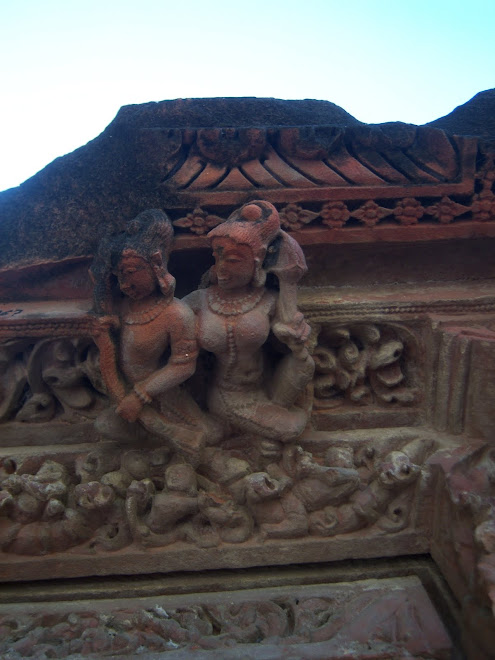
Chandravati temple sculpture

golden sun-rays kiss softly life and the Bells of Joy sing a hymn--Jhalawar-Patan

I do not know what to say now but I will come to you when the muse holds me in her inspiring arms!!

Search This Blog

Pages

Popular Posts

Showing posts with label Kolvi Buddhist caves. Show all posts

Saturday, March 12, 2011

Jhalrapatan, Jhalawar Rajasthan


My new book on Indian art Mona Lisa does not smile anymore owes a lot to Rajasthan in general and Jhalwar in particular. As I travelled time and again to Rajasthan trying to learn the great history of art of India, I garnered fresh insights in the minds of Indian artists from this part of my beautiful country. The areas of Bundi, Jhalwar, Kolvi, Menal, Bijolia, Kota have a common cultural heritage. The people of these areas even today are saturated in their cultural traditions. Almost in all the wonderfully exquisite temples that I visited in this area even today reflect same kind of simplicity of faith that created these temples a 1000 years or so earlier. This is true of all the Rajasthan. I met in these pristine old temples the simple, poor folk of my country incomparable in the warm welcoming smiles and they gave affection strangers rarely get anywhere.
In this Blog post I express my deepest gratitude and thankfulness to these great Indian. What is heartening is that the spiritual and social light of these folks was understood very well by the artists, sculptors, painters of India from centuries past. On the wall of all temples are gods and goddesses but are also simple village folk who are carrying on their daily activities or are rejoicing in the music and dance. Such a cameo of the life of ordinary people I did not find anywhere in the world including Europe, where the focus is mostly on religious narrative.
Some European historians suggest that Indians being laid back and fatalist I have refuted in my Mona Lisa...book. Indians from time past never questioned or denigrated other cultures and faiths though they kept to their own in harshest of circumstances. The faith of Indians is a fine example of freedom in religion. There is no organised centralised religious control. There is no dominant religious authority that controls and guides the laity. The God is personalised and a village farmer or an artisan making pottery is as free to find his communion with higher powers as a rich industrialist living in a 2 billion dollar mansion.
I owe this insight to the common people of India who never hold themselves back from sharing their simple joys in religion and with other humans.

Sunday, November 28, 2010

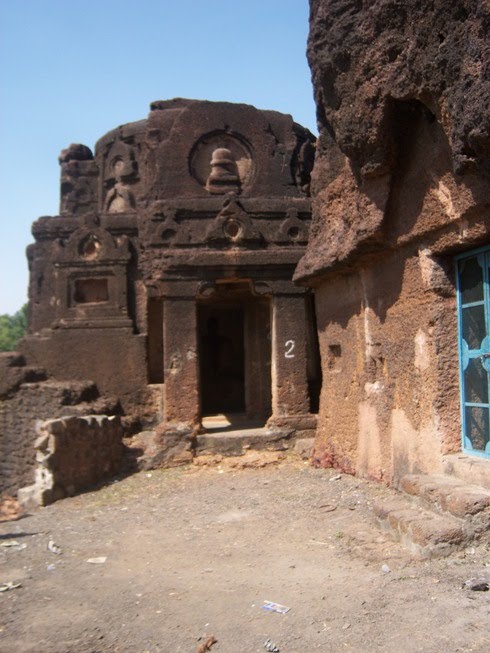
Buddha in Jhalawar--Kolvi Caves

Buddha --Meditating
Buddha Standing
Chaitya


Buddha--kolvi
The time as I said earlier is a snail in Jhalawar. You may arrive as a stranger but you will go back as family and friend is the culture and the sweetness of Jhalawaris. Kush Sherma whose great help to see the exiquisite art in Garh Palace I have already mentioned suggested to me take an early morning bus to Dag to enable me to visit Buddhist Kolvi Caves. I took a bus 6AM (Jhalawar to Banswara) from near the Rajasthan Tourism Office in Jhalawar. The bus drove through small villages, taking passengers, there were a lot of sheep on the road and colourful women shepherd in their exotic jewelery saw to it that no ewe is left behind, the sheep dog also worked hard to maintain order in flock. Some tribal women got on to the bus and their red and blue skirts and mirror work on shirts and armful of white bangles were distinct. it was about 95 kms. to Kolvi. The bus left me on the road and went on further to Dag another 10 kms from kolvi. I walked on a fine tarred road arrived in open country and small settlements. A water pond had women come down to wash clothes while the cattle cooled in the water.
Walking about 3 kms i arrived near a small hillock. I noticed ASI board about Kolvi caves. i went up the hill and there was total silence only the sound of wind. the foliage swayed in wind and I could see far the sun burnt landscape. At leisure I explored the caves 35 of which still remain out a more than 50. The weathering by elements has destroyed the sutpas and Chaityas. the caves had the stone bed for the monks to sleep on. from the doors of caves which mostly opened to the valley bellow it would have been a stupendous view of forests, and wilderness more than 1500 hundred years before. the vegetation might have been different 1500 years before. the monks must have had fruits from the trees in the forest and food brought from villages. I could feel the presence of monks their discussions on Dhamma and their simple spiritual lives.
I understand that these caves continued in use till at least 12th century which speaks for the popularity of Buddhism in the area. There was a giant sized standing Buddha sculpture and many in meditative posture. erosion has taken its toll but still the place gave me a feeling of peace and a distance from the world of humans into serene nature. in one of the caves someone has put an idol and i could feel that locals visit and worship. So in India nothing dies, faith keeps alive 1500 years after the monks prayed for Nirvana. i spent quite many hours in this little hill of peace. had a banana and few biscuits and washed them down with a couple of swigs of water from the bottle. I walked back the women and men worked their farms, tethered the oxen to the carts and children played and ran around in joy. Soon another bus appeared and I went to Dag a small dusty town. I took some mango drink and walked around. Farmers brought grains and lentils to sell in the shops. People shopped for shoes and clothes, utensils and groceries. This was my India not the CFL powered glitter of big cities but the sinewy, hardy, sturdy farmers' world of simplicity and modest desires. The honest toil visible on the faces of men with their dauntingly large mustaches and bright headgear the women elegant in their bronzed faces from honest and hard labour in fields and at home.
Note-- take water and food with you for in Kolvi there is nothing. Have a sun hat while you walk up to the caves in strong tropical sun. Travel by the local bus you will learn more about people and culture. Near Dag are more caves if you would like to visit